Image credit : @oviegreat8 via facebook
In professional sports, athletic longevity is usually judged by how long a player lasts in the league. But in hockey, where everything is a high-pressure machine, the “real” marker of greatness is often built across entire generations. So you get these rare, iconic families who lock in their instincts, their physical approach, and that no-nonsense routine, passing down a real hands-on template of elite performance from fathers to sons, and brothers to cousins too.
These hockey dynasties suggest that top-tier talent isn’t only some brief lightning flash. It can be shaped through both genetics and environment, and then it helps a family stay dangerous across different eras. And when you look at the sport’s most famous bloodlines, you start to see how a kind of structural hockey intelligence gets transmitted over decades, almost like a system that won’t quit.
The Tkachuk Family
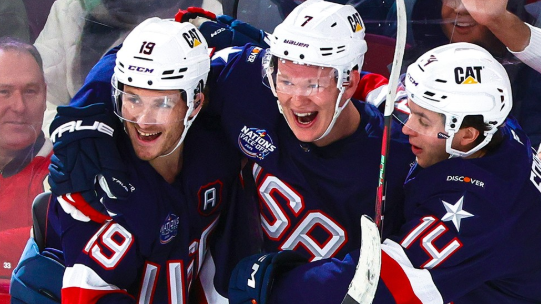
Not many hockey families have shaped North America’s identity like the Tkachuk group. This lineage is known for a relentless mix of high-level offensive output and punishing old-school physicality. The core tone was set by United States Hockey Hall of Famer Keith “Big Walt” Tkachuk, who played the power forward game at an elite level. He racked up over 500 goals and had a reputation for making opposing defensive setups look completely out of place.
That same heavy, high-leverage way of operating has been repeated by his sons, Matthew and Brady Tkachuk. Matthew helped lead deep playoff runs with the Florida Panthers, including a Stanley Cup championship, using elite net-front positioning plus clutch playmaking. Meanwhile, Brady serves as captain of the Ottawa Senators with that same bruising, puck-centered style that carries forward what his father established. The Tkachuks remain a measuring stick for the modern power-forward role throughout the league.
The Sutter Family
If you’re talking about sheer volume and cultural weight, the Sutter family pretty much sits alone. They’re almost like a full-on hockey enterprise. Coming from the small farming community of Viking, Alberta, the first wave hit a remarkable milestone: six brothers—Brent, Brian, Darryl, Duane, Rich, and Ron— all reached the NHL during the late 1970s and 1980s, and together they logged thousands of regular-season games. Their name became linked to work ethic, defensive responsibility, and a kind of structural toughness that didn’t soften.
Then the legacy slid right into the next generation, when the brothers moved from playing into elite front-office work and championship-level coaching and Darryl Sutter helped guide two Stanley Cup wins as head coach of the Los Angeles Kings. Brent and Brian also earned Jack Adams Awards for coaching excellence. And it didn’t stop there, because cousins Brandon, Brett, and Brody Sutter later reached the professional level too, keeping that family standard intact: disciplined two-way tracking and strong physical play.
The Hughes Family
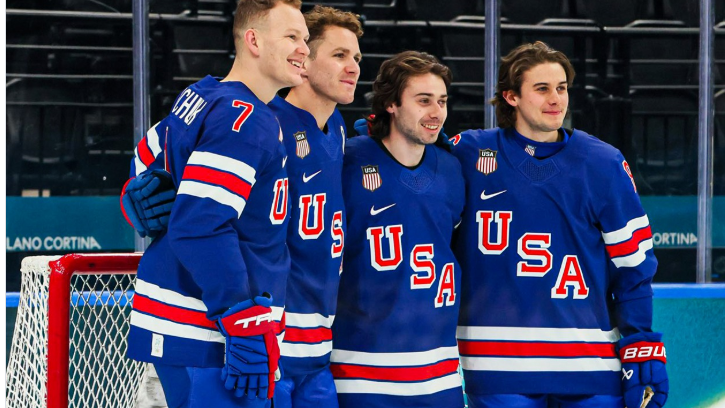
Earlier dynasties often leaned on physical grind and attrition, but the Hughes family feels more like the modern, calculated evolution of hockey. Their setup has a strong organizational background: father Jim Hughes spent years working in hockey management and development roles, while mother Ellen Weinberg-Hughes was a high-level athlete for Team USA. With that foundation, the family produced one of the most mechanically explosive sets of brothers in today’s game.
All three brothers were drafted within the top seven picks of their respective drafts, which is a rare level of developmental consistency and Quinn Hughes has reshaped modern offensive defense play, becoming a Norris Trophy-winning blueliner who uses elite lateral edge work to disrupt defensive tracking patterns from the point. Up front, Jack Hughes plays like a franchise-changing accelerant, producing elite offensive numbers with sharp processing speed. And Luke Hughes, the youngest, brings many of those same high-velocity skating mechanics from the back end.
Overall, the brothers’ hockey IQ leans heavily on spatial awareness and rapid transition play. It’s the kind of tactical future that feels built for the speed and spacing of the modern game.
About the Author